
Real-World Applications

AI voice interfaces built for your product and site

mpWAV provides the integrated voice interface stack — single-microphone noise removal, multi-microphone echo and noise preprocessing, wake-word detection, sound source localization, speech separation, speaker diarization, on-device speech recognition, and a conversational LLM.

For product environments as different as robots, kiosks, vehicles, appliances, smart devices, and meeting systems, we select the required technologies and connect them into one working architecture.

Technology Matched to the Environment

How does the right voice technology differ by industry?

mpWAV analyzes your product's microphone count, speaker output, user position, number of speakers, noise environment, and service goal to compose the right combination of voice technologies.

Earbuds with limited microphone options start from mpNC; multi-channel robots from mpAEC, mpBeamforming, and mpLocalization; meetings from mpSeparation and mpDiarization; conversational kiosks from mpASR and mpLLM.

We don't force one generic algorithm onto every product — we design the voice stack around the product's conditions.

Application Overview

Pick the product and environment you're solving for

Robots

Multi-channel voice interfaces for products that move and speak

Helps robots detect the user's call, find the direction the voice came from, and accurately recognize commands amid their own speakers and motor noise.

  • mpWWD
  • mpLocalization
  • mpAEC
  • mpBeamforming
  • mpAB
  • mpASR
  • mpLLM
See robot applications

Kiosks

Voice ordering and on-device dialogue in store noise

Captures the user's voice with a multi-channel array, removes store noise and prompt echo, then understands order intent and options through recognition and a conversational language model.

  • mpAB
  • mpASR
  • mpLLM
  • Multi-channel Audio I/O HW
See kiosk applications

Vehicles & mobility

Voice commands amid driving noise and car audio

Removes car audio echo and road noise, then analyzes the wake word, seat or speech direction, and voice commands.

  • mpWWD
  • mpLocalization
  • mpAEC
  • mpBeamforming
  • mpAB
  • mpASR
  • mpLLM
See vehicle applications

Appliances, smart devices & earbuds

Single-microphone processing for products with limited mic options

For earbuds, wearables, and small smart devices where an array isn't possible, one microphone is enough to remove ambient noise.

  • mpNC
  • mpWWD
  • mpASR
  • mpLLM
See appliance & smart device applications

Meetings & voice chat

Separating voices and organizing them by speaker

Separates multi-party and overlapping speech by speaker, tells who spoke when, then connects meetings to transcripts and summaries.

  • mpSeparation
  • mpDiarization
  • mpAEC
  • mpBeamforming
  • mpASR
  • mpLLM
See meeting applications

Factory anomaly detection

Detecting abnormal sounds amid complex equipment noise

Analyzes acoustic signals so abnormal motor and equipment sounds can be detected even on noisy production lines.

  • mpAEC
  • mpBeamforming
  • mpAB
  • mpSeparation
  • Anomaly Detection
  • Mic-Array HW
See factory applications

Defense & special environments

Voice interfaces for extremely noisy environments

Implements voice preprocessing, wake-word detection, on-device recognition, and dedicated hardware for extreme ambient noise and constrained networks.

  • mpAEC
  • mpBeamforming
  • mpAB
  • mpWWD
  • mpLocalization
  • mpASR
  • HW
See defense applications

Hearing assistance

Smoother everyday communication in noise

ClearSense Audio, running on a smartphone with ordinary earphones, applies mpWAV clarity enhancement to everyday conversation and public hearing welfare.

  • mpNC
  • ClearSense Audio
See hearing assistance

Robotics

So robots detect the user's call and position — and respond in real noise

Robots run motors and cooling fans while delivering prompts and responses through their own speakers.

Users may call from any direction, not just the front, while nearby conversation and room reflections also enter the microphones.

mpWAV connects echo cancellation, multi-microphone noise removal, wake-word detection, localization, and recognition-plus-dialogue into the robot's complete voice interface.

mpAEC

Removes echo from the robot's own prompts and responses.

mpBeamforming·mpAB

Removes motor, fan, and nearby-conversation noise, strengthening the target voice.

mpWWD

Detects the wake word and activates the robot's listening state.

mpLocalization

Estimates the direction or position of the user's voice.

mpASR

Converts commands into text or robot control commands.

mpLLM

Interprets natural-language commands, questions, and dialogue context.

Far-field robot speech recognition in a noisy room, running on our own mic array.

Conversational Kiosk

From accurate recognition in store noise to conversational automated ordering

Accurate recognition in store noise is essential for kiosk voice ordering.

On top of that, users phrase menus and options in many ways, missing information requires follow-up questions, and the final result must reach the ordering system.

mpWAV connects a linear microphone array and multi-channel audio I/O hardware, mpAB preprocessing, mpASR recognition, and mpLLM to deliver dialogue generation and automated ordering.

Linear mic array & multi-channel audio I/O HW

Captures the user's speech in front of the kiosk on multiple channels.

mpAB

Removes store conversation, background music, and kiosk prompt echo, enhancing the user's voice.

mpASR

Converts menu names, options, quantities, and order utterances into text.

mpLLM

Interprets intent and context to understand the order, asking follow-up questions for missing information.

Automotive and Mobility

From wake word to natural-language commands, amid driving noise and car audio

A car cabin combines engine and road noise, HVAC, music, and passenger conversation at once.

The voice interface must cancel car audio echo, recognize the wake word, identify which seat or direction spoke, and then understand commands and natural-language requests.

mpAEC

Removes echo from car audio and voice prompts.

mpBeamforming·mpAB

Removes driving noise and passenger conversation, enhancing the user's voice.

mpWWD

Detects the automotive wake word.

mpLocalization

Estimates speech direction and seat position.

mpASR

Recognizes navigation, climate, media, and other vehicle commands.

mpLLM

Connects natural-language requests and context to vehicle functions.

Home Appliances, Smart Devices and Earbuds

AI voice technology for devices with limited microphone options

Earbuds, wearables, and small smart devices often cannot fit multiple microphones due to size, layout, and power constraints.

mpNC removes ambient noise from a single microphone input, making voice input improvement and a voice interface feasible on single-mic products.

mpNC

Reduces everyday ambient noise from a single microphone input and enhances the user's voice.

mpWWD

Detects the wake word to activate product functions.

mpASR

Recognizes commands and short utterances on-device.

mpLLM

Connects product functions with natural-language requests.

Applicable products

  • Home appliances
  • Wireless earbuds
  • Phone accessories
  • Wearables
  • Portable smart devices
  • Voice-controlled IoT devices

Meeting and Voice Chat

Separating voices and telling speakers apart where many people talk

Meetings and voice chat combine multiple talkers, speaker echo, far-field voices, and overlapping conversation.

mpWAV uses mpSeparation to separate multi-party input by speaker, mpDiarization to tell who spoke when, then mpASR and mpLLM to extend into transcripts and summaries.

mpSeparation

Separates multi-party or overlapping voice input.

mpDiarization

Separates per-speaker segments and speaker turns.

mpAEC

Removes echo from remote participants played through the loudspeaker and re-entering the microphone.

mpBeamforming

Removes ambient noise and enhances the meeting audio.

mpASR

Transcribes the meeting audio.

mpLLM

Organizes summaries and key decisions.

Applicable services

  • In-person meetings
  • Video conferencing
  • Voice chat
  • Consultation records
  • Interview analysis
  • Automated minutes
  • Multi-party voice analytics
Separating who said what when several people talk over each other in a noisy room.

Industrial Acoustic Anomaly Detection

Detecting equipment anomalies amid complex production noise

On a production line, many motors and machines run at once, making the target equipment's sound hard to measure.

Building on its real-environment noise processing, mpWAV estimates the target equipment's acoustic signal and detects normal versus abnormal patterns.

Acoustic preprocessing

Estimates the target equipment's acoustic signal from complex line noise.

Anomaly detection model

Detects anomalies from the target equipment's acoustic signal.

Acoustic capture edge HW

Collects acoustic data directly at the equipment.

Licensing

Develops data-driven models fit to your equipment and production environment.

Applicable areas

  • Motor anomaly sounds
  • Rotating equipment
  • Line acoustic inspection
  • Equipment condition monitoring
  • In-line quality inspection

Defense and High-Noise Environments

Voice interface structures for extreme noise and constrained connectivity

Defense and special environments can require handling extreme ambient noise, limited networks, and embedded compute constraints together.

mpWAV delivers an embedded system solution combining multi-channel preprocessing, wake-word detection, and on-device recognition.

mpAEC · mpBeamforming · mpAB

Multi-channel preprocessing amid extreme ambient noise.

mpWWD

Wake-word based interface activation.

mpASR

Network-independent on-device speech recognition.

Embedded system solution

Delivers a real-time embedded system solution.

Hearing Support and Smart Listening

Extending voice technology to everyday conversational clarity

ClearSense Audio is a smart listening solution that helps people hear conversation in ambient noise crisply and clearly, using a smartphone and ordinary earphones.

It extends mpWAV's single-microphone noise removal and voice enhancement into a range of B2C products and public hearing welfare.

mpNC

Removes ambient noise from the captured signal and strengthens the other person's voice.

Mobile processing

Supports product structures using a smartphone and ordinary earphones.

Effortless listening experience

Delivers a differentiated listening experience with the smartphone and ordinary earphones you already own — no dedicated equipment.

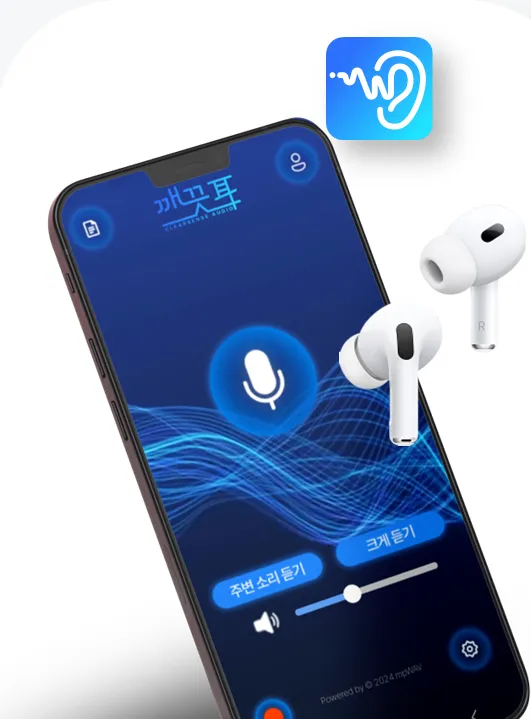
A smartphone running the ClearSense Audio app next to ordinary wireless earphones. The screen shows ambient listening and amplification controls
ClearSense Audio running on a smartphone with ordinary wireless earphones

Application Technology Matrix

Key technology combinations by application

Scroll horizontally to see all columns

ApplicationInputSpeech RefinementRecognition & DialogueImplementation
RobotsmpAEC·mpBeamforming·mpABmpWWD·mpASR·mpLLM·mpLocalizationMic Array·DSP·FPGA·AP
KiosksmpAEC·mpBeamforming·mpABmpWWD·mpASR·mpLLMLinear Mic Array·AP·DSP
Vehicles & mobilitympAEC·mpBeamforming·mpABmpWWD·mpASR·mpLLM·mpLocalizationMic Array·DSP·FPGA·AP·SoC
Appliances, smart devices & earbudsmpNCmpWWD·mpASR·mpLLMEdge·lightweight models
Meetings & voice chatmpAEC·mpBeamforming·mpABmpSeparation·mpDiarizationmpASR·mpLLMPC·Server·Edge
Factory anomaly detectionPreprocessingAnomaly DetectionMic Input System·License
Defense & special environmentsmpAEC·mpBeamforming·mpABmpWWD·mpASREmbedded System
Hearing assistancempNCMobile·ClearSense Audio

This table is a general guide. Real projects finalize the combination based on product hardware, data, latency, and service goals.

Find the Right Technology

Pick the voice problem your product faces

Product problemRecommended technology
Limited microphone optionsmpNC
Echo from the product's own speakermpAEC
Removing ambient noise with multiple micsmpBeamforming
Echo and noise at the same timempAB
Detecting a wake wordmpWWD
Separating multi-party voice inputmpSeparation
Knowing the speaker's direction or positionmpLocalization
Telling who spoke whenmpDiarization
Converting speech to text or commandsmpASR
Understanding context and intentmpLLM
Multi-channel audio I/O and real-time processingMulti-channel Audio I/O HW

Delivery Options

Delivered to match your development stage

Software

Apply mpWAV technology while keeping your existing product and ASR.

PoC · validation

Before-and-after comparison with your real product audio and field data.

Mic array & multi-channel audio I/O module

Multi-channel input, speaker output, and the AEC reference connected in one structure.

FPGA·DSP·AP porting

Runs mpWAV technology on your embedded compute platform.

On-device model optimization

Fits mpASR and mpLLM to the target product's memory and compute budget.

Licensing·co-development

Preprocessing, acoustic analysis, and conversational interfaces co-developed around your product data.

SoC·semiconductor IP

Dedicated voice interface structures for volume production and miniaturization.

Application Experience

Applicability validated in real products and sites

Robots

ASR preprocessing for home, showroom, and care robots

Kiosks

Multi-channel audio I/O and preprocessing modules, recognition and automated ordering

Mobility

ASR preprocessing in real in-vehicle noise

Factories

Motor anomaly detection validated amid complex production noise

Hearing assistance

ClearSense Audio usability reviewed at welfare centers

From Use Case to Product

We design the right stack starting from your product's usage scenario

  1. 1

    Define the application and features

    Wake-up, commands, dialogue, meeting records, or anomaly detection — we scope what you need.

  2. 2

    Analyze the acoustic structure

    Microphone count, speaker output, user distance, and the noise environment.

  3. 3

    Review real data

    Single/multi-channel raw audio, the AEC reference, and your current ASR results.

  4. 4

    Design the technology combination

    Select from mpNC, mpAEC, mpBeamforming, mpAB, mpWWD, mpSeparation, mpLocalization, mpDiarization, mpASR, and mpLLM.

  5. 5

    PoC & validation

    Evaluate audio quality, detection rates, localization and diarization, recognition, dialogue results, and latency.

  6. 6

    Platform integration

    Apply as software, a mic array, DSP, FPGA, AP, or an edge environment.

  7. 7

    Connect the product API

    Deliver recognition and dialogue results to robot control, ordering, vehicle functions, meeting systems, or alerting.

  8. 8

    Field verification

    Verify performance where the product is actually used, under its real noise.

  9. 9

    Production & expansion

    Review follow-up products, platforms, model optimization, and SoC expansion.

FAQ

Frequently asked questions about mpWAV applications

Robots, kiosks, vehicles, home appliances, smart devices and earbuds, meetings and voice chat, factory acoustic anomaly detection, and hearing assistance.

Defense and special environments are handled as dedicated hardware and co-development areas.

mpNC — noise removal from a single microphone.

Earbuds, wearables, and small smart devices, where size, component layout, and power rule out an array.

If your product can take several microphones, mpBeamforming removes more noise.

Yes — the two work together.

mpWWD detects the wake word while mpLocalization uses multi-microphone input to estimate the direction or position of the voice.

Yes.

mpAB removes store noise and prompt echo, mpASR converts speech to text, and mpLLM interprets menu, options, quantity, and context.

The real ordering API and target hardware still need validation.

Yes — there is a demo video in the meetings and voice chat section of this page.

It shows mpSeparation splitting speech by speaker while several people talk over each other in noise.

Add mpDiarization to work out who spoke when and mpASR on top, and you get a per-speaker transcript.

Five things decide it: microphone count, whether the product has a speaker, distance to the user, how many people speak at once, and the final feature.

Earbuds have one microphone, so mpNC. A robot has both its own speaker and motor noise, so mpAB plus mpWWD and mpLocalization.

The per-industry sections above set out each combination — and if yours is not there, tell us the product conditions and we will put one together.

No.

Depending on microphone count, speakers, user position, number of talkers, and required features, you can select only what you need.

Yes.

Starting from the usage scenario and required voice features, we can review microphone structure, the technology combination, and data collection conditions.

Robots, kiosks, mobility, home appliances, smart devices, hearing assistance, meetings and voice chat, defense, and factory anomaly detection — as AI drives voice interfaces into more categories, the technology applies to nearly any field.

Design Your Application Stack

Design the voice technology your product needs — starting from the application

Tell us your product type, microphone count, speaker structure, noise environment, and the features you want to build — we will review the right mpWAV stack.

From single-mic and multi-channel noise-removal preprocessing to speaker, wake-word, and location analysis, on-device ASR, and a conversational LLM — we deliver a solution tailored to your product.