Cafes and restaurants
Customers who are not used to touch ordering give up or look for staff. mpKiosk opens a second way to order: by voice. The kiosk you run today stays.


mpKiosk · AI Conversational Kiosk Solution
Keep the kiosk you already run and add voice ordering, or install a new full set.
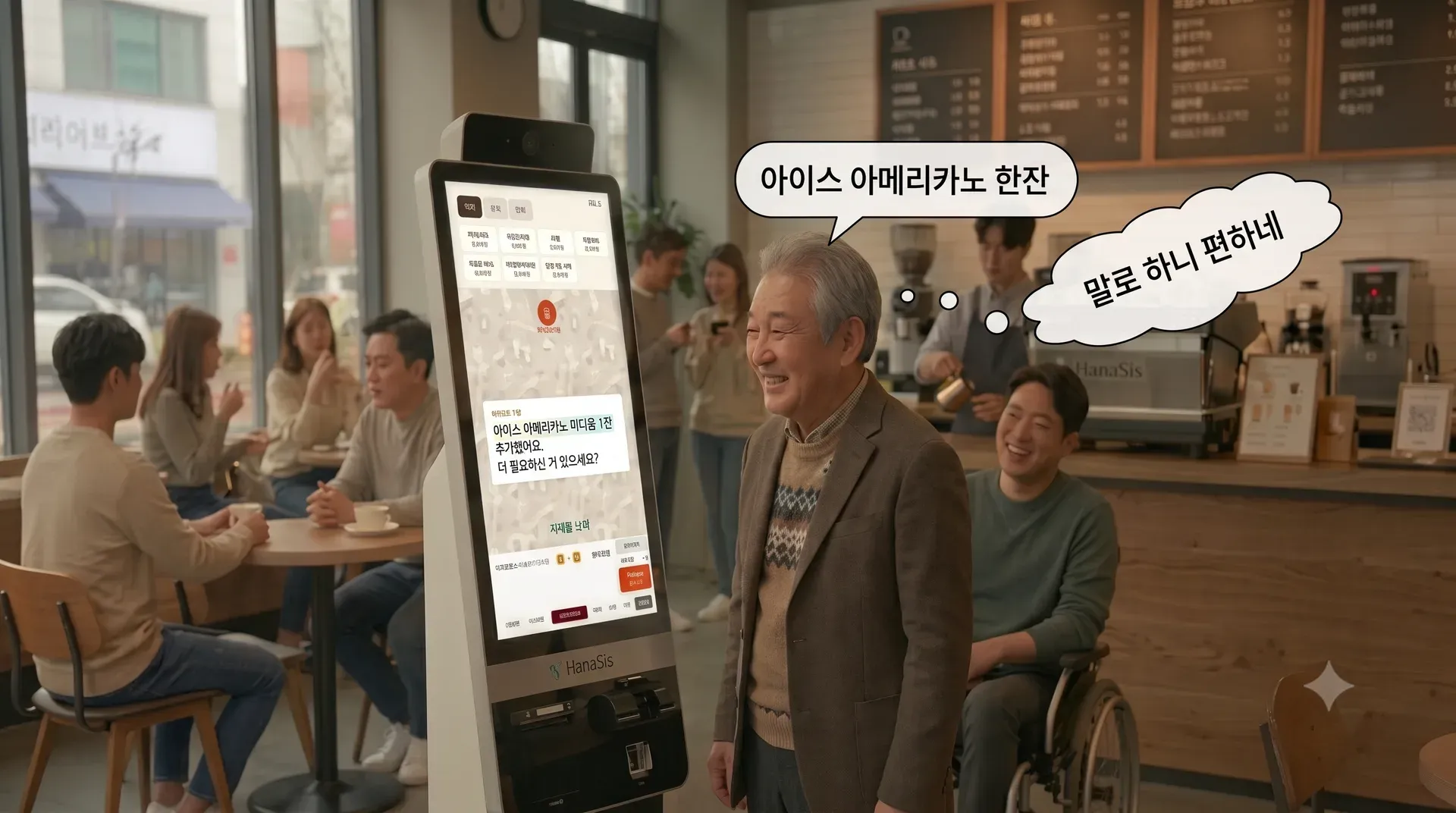
mpKiosk is an AI conversational, barrier-free kiosk solution made by mpWAV Inc. in Seoul, Korea. Even over store music and nearby conversation, a customer orders by speaking as they would to staff; the kiosk works out the menu item, quantity, and options, and payment is completed by voice or touch. It comes in two forms: a conversion kit that attaches a microphone array module to a Windows or Android kiosk already in service (approx. KRW 0.7–1.0 million), and a full set installed as a new unit (approx. KRW 3 million). Prices are reference prices excluding VAT. mpKiosk holds Grade 1 verification as a priority-purchase intelligent information product from Korea's Ministry of Science and ICT (Reg. No. 2026-444, 2026-445), and recorded a 95.45% voice order success rate in store noise in TTA accredited test TTA-26-01991.
Last updated
Who it is for
Customers who are not used to touch ordering give up or look for staff. mpKiosk opens a second way to order: by voice. The kiosk you run today stays.
The conversion kit attaches to Windows or Android ordering kiosks already in service. We run a compatibility check on each store's model before installation.
The product holds Grade 1 verification as a priority-purchase intelligent information product (self-service ordering terminal) from Korea's Ministry of Science and ICT. Service and information-desk kiosks are being added.
Two ways to adopt
Both options run the same software with the same recognition performance. Only the hardware differs.
Adds voice ordering to a kiosk in service, without replacing it
Approx. KRW 0.7–1.0 millionReference price, VAT excluded
For stores that already run a kiosk.
A new kiosk unit with voice ordering built in
Approx. KRW 3 millionReference price, VAT excluded
For new stores, or stores replacing an old kiosk.
Prices are reference prices as of November 2026, excluding VAT, and vary with configuration, quantity, and installation conditions.
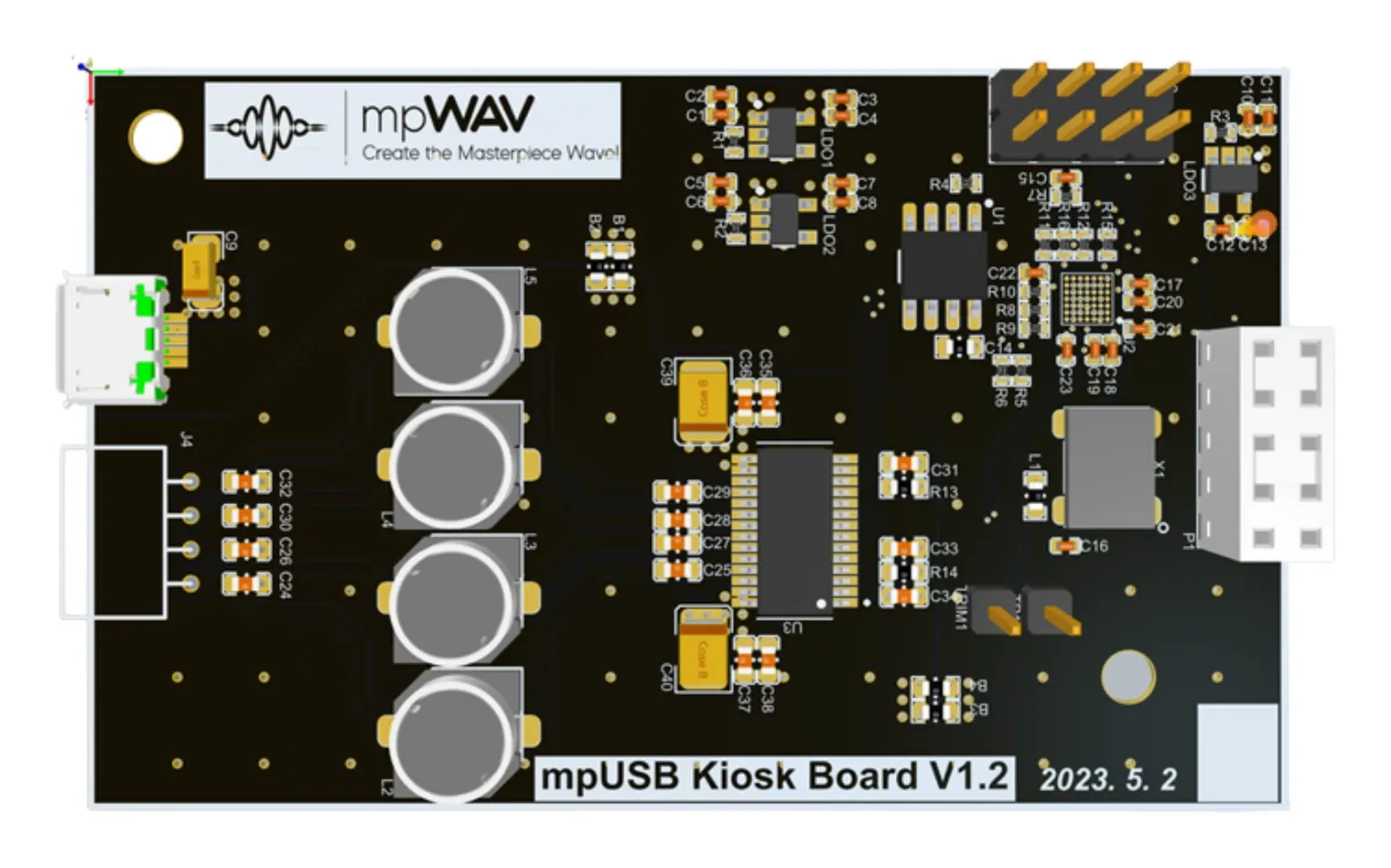
The microphone board and main board added to a kiosk already in service.

How ordering works
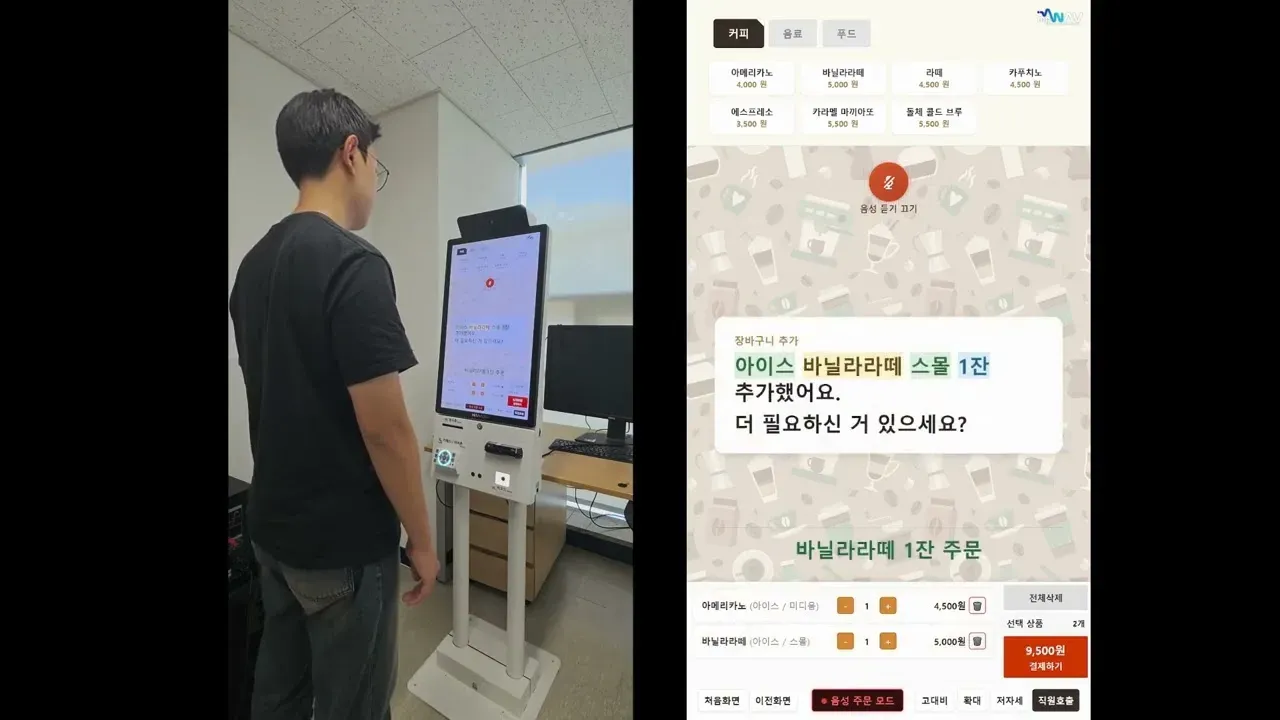
A proximity sensor detects the customer and voice guidance begins.
“Two iced americanos, large.” The customer says the order instead of searching the menu.
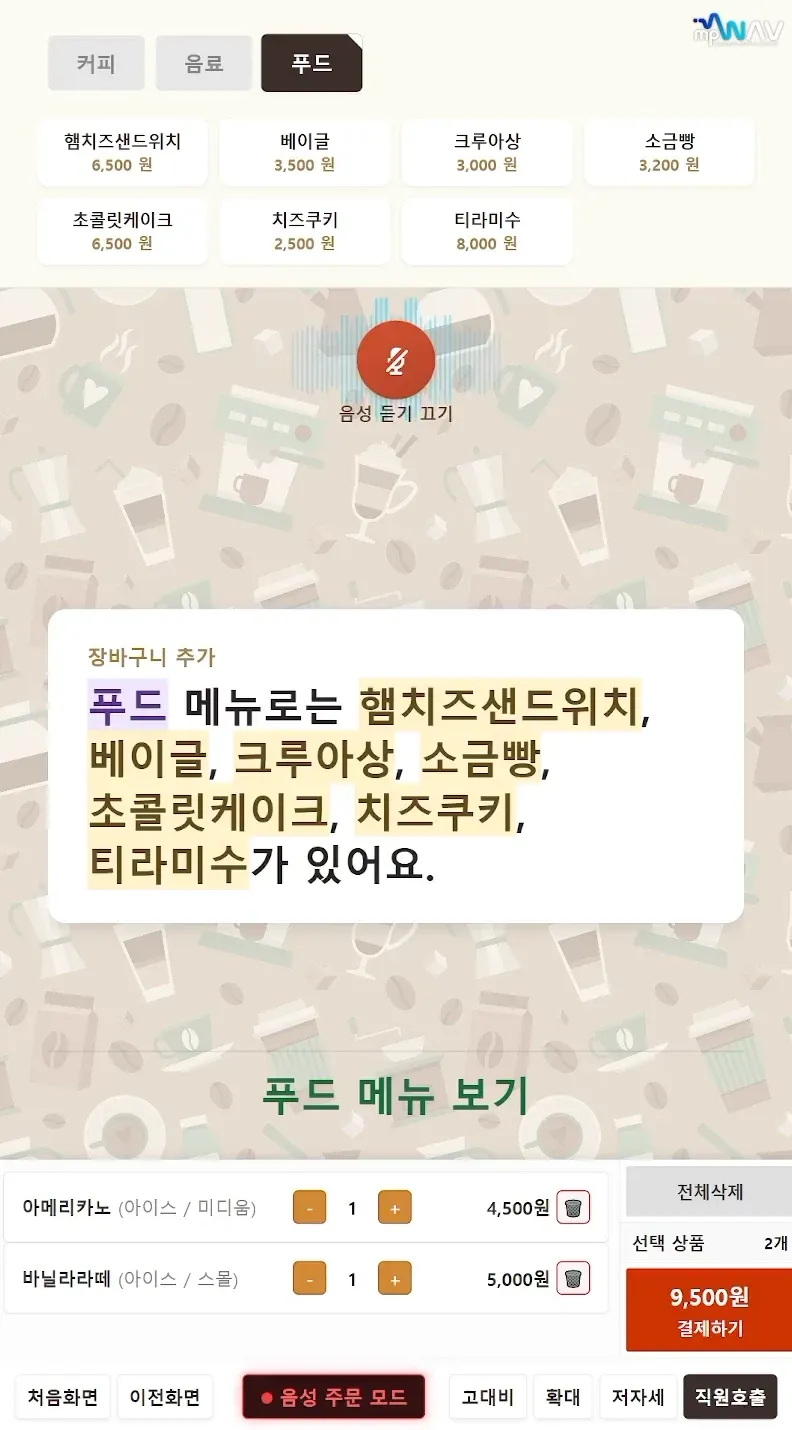
Menu items, quantities, and options are laid out on the screen.
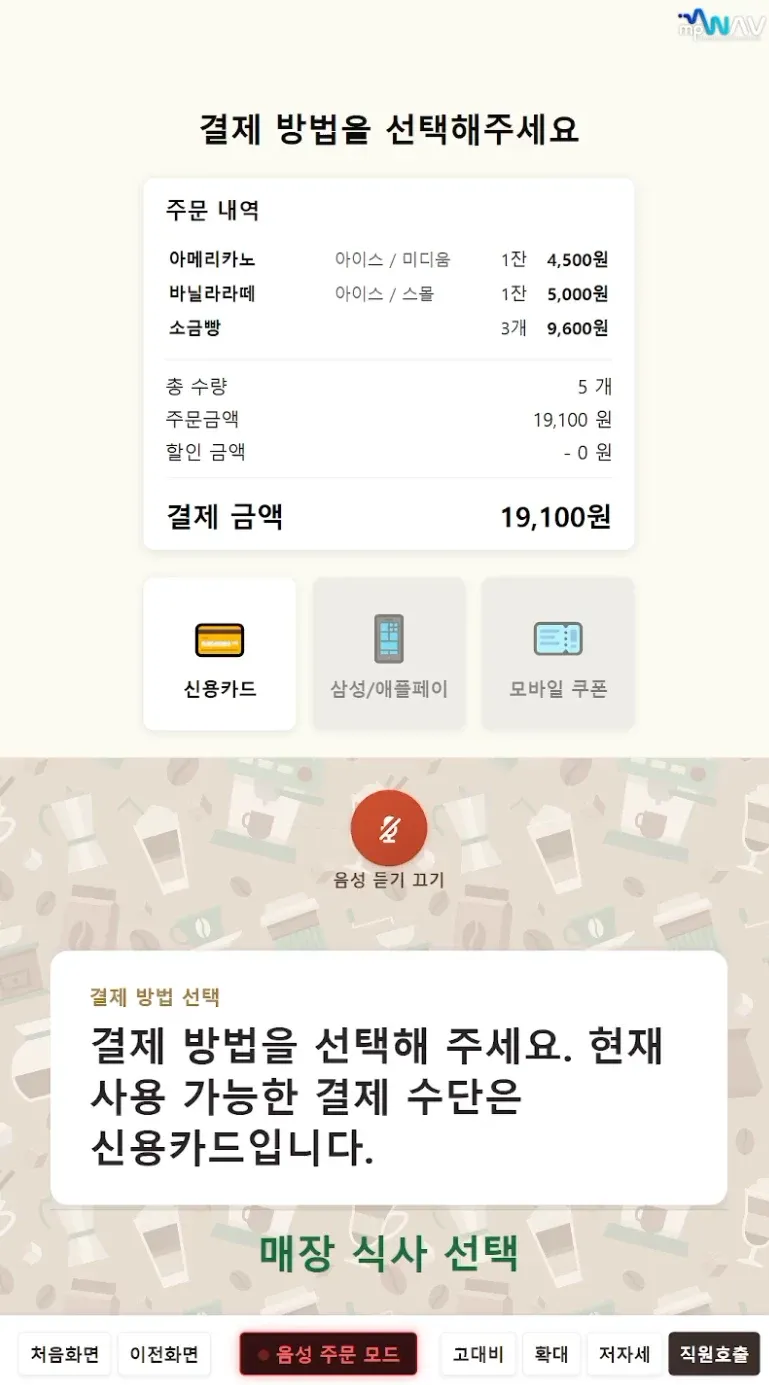
Finish by voice or by touch.
Demo video
See the kiosk take a spoken order. The video is in Korean.
Key features
When store music, nearby conversation, and the kiosk's own voice guidance overlap, microphone array beamforming and multichannel echo cancellation pick out the customer's voice.
There is no need to wait for the voice guidance to finish. The kiosk recognises speech that cuts in partway (barge-in).
Natural speech is broken down into menu item, quantity, temperature, and size, and becomes an order line.
Older customers, blind and low-vision customers, and wheelchair users can order by voice; customers used to the screen can touch. The two can be mixed in one order.
A DSP built into the module removes noise and echo in real time, and speech recognition and the language model follow straight on.
Streaming speech recognition specialised for the store's menu. The menu is registered at installation.
Performance and evidence
Every number below names its testing or verifying body. We share detailed test conditions from the report during consultation.
Telecommunications Technology Association (TTA), Korea · Report No. TTA-26-01991
Minister of Science and ICT, Korea · Digital Inclusion Act, Article 23(4)
Nonhyeon Senior Welfare Center, Seoul
mpWAV speech preprocessing
Specifications
Scroll sideways to see the whole table
| Item | Conversion kit | Full set |
|---|---|---|
| Included | Microphone array and speaker module, voice ordering software and menu screens | Kiosk unit (touch display, payment module, printer), voice module, voice ordering software and menu screens |
| Audio input | MEMS microphone array, 4–6 channels + 2 echo reference channels, 16 kHz 16-bit | Same |
| Audio output | 2-channel speaker amplifier (3 W at 5 V / 10 W at 12 V), 48 kHz 16-bit | Same (speakers built into the unit) |
| Connection and power | USB Audio Class 1.0 (Type-B), USB 5 V bus power or 12 V external supply | AC 220 V, wired LAN or Wi-Fi for payment approval |
| Voice ordering stack | Real-time preprocessing on a built-in DSP (mpAB) + speech recognition and language model | Same |
| Compatible kiosks | Windows or Android ordering kiosks with a USB port, after a compatibility check | Not applicable |
| Size | Linear microphone board 205.99 × 12.70 mm, main board 55.88 × 43.17 mm | Display size and stand type agreed to suit the store |
| Installation and support | Half-day on-site installation including menu registration and staff training; remote updates | Same |
mpKiosk currently serves cafe ordering kiosks. Other restaurant ordering, hospital and pharmacy reception and payment, airport and station ticketing, and public service and information kiosks are being added.
How to adopt
We ask about the store type, the kiosk in use, and the noise environment.
For the conversion kit we check compatibility with the existing kiosk. For the full set we agree the display and stand.
We quote for the configuration, quantity, and installation conditions.
On-site installation takes half a day. We register the store's menu and train staff.
Once in service, we support the kiosk with remote updates.
Frequently asked
Yes. The mpKiosk conversion kit adds voice ordering to a Windows or Android ordering kiosk that has a USB port.
A microphone array and speaker module mounts on the outside of the kiosk and the software is installed. Conditions differ by model, so we run a compatibility check first.
The conversion kit is approximately KRW 0.7–1.0 million and the full set approximately KRW 3 million. Both are reference prices excluding VAT.
The actual amount varies with configuration, quantity, and installation conditions, so we confirm it in a quote after consultation.
On-site installation takes half a day. The conversion kit is done in a single visit.
Menu registration and staff training happen during the same visit.
No. Touch ordering keeps working. Voice and screen are offered together, so a customer can mix the two within one order.
The conversion kit leaves the existing menu and payment flow unchanged and adds a voice ordering screen.
Yes. In the TTA accredited test (TTA-26-01991), the voice order success rate in store noise was 95.45%.
Microphone array beamforming and echo cancellation filter out store music, nearby conversation, and the kiosk's own voice guidance to recognise the customer's voice.
The configuration on this page is for the Korean market: Korean-language ordering screens, AC 220 V power, and prices in KRW.
For other regions and languages, contact us with your market and kiosk platform.
Yes. For manufacturers we provide a microphone array module and software licence instead of a finished product.
Talk to us
Whether you already run a kiosk and how many units you need is enough for us to say whether the conversion kit or the full set fits.